
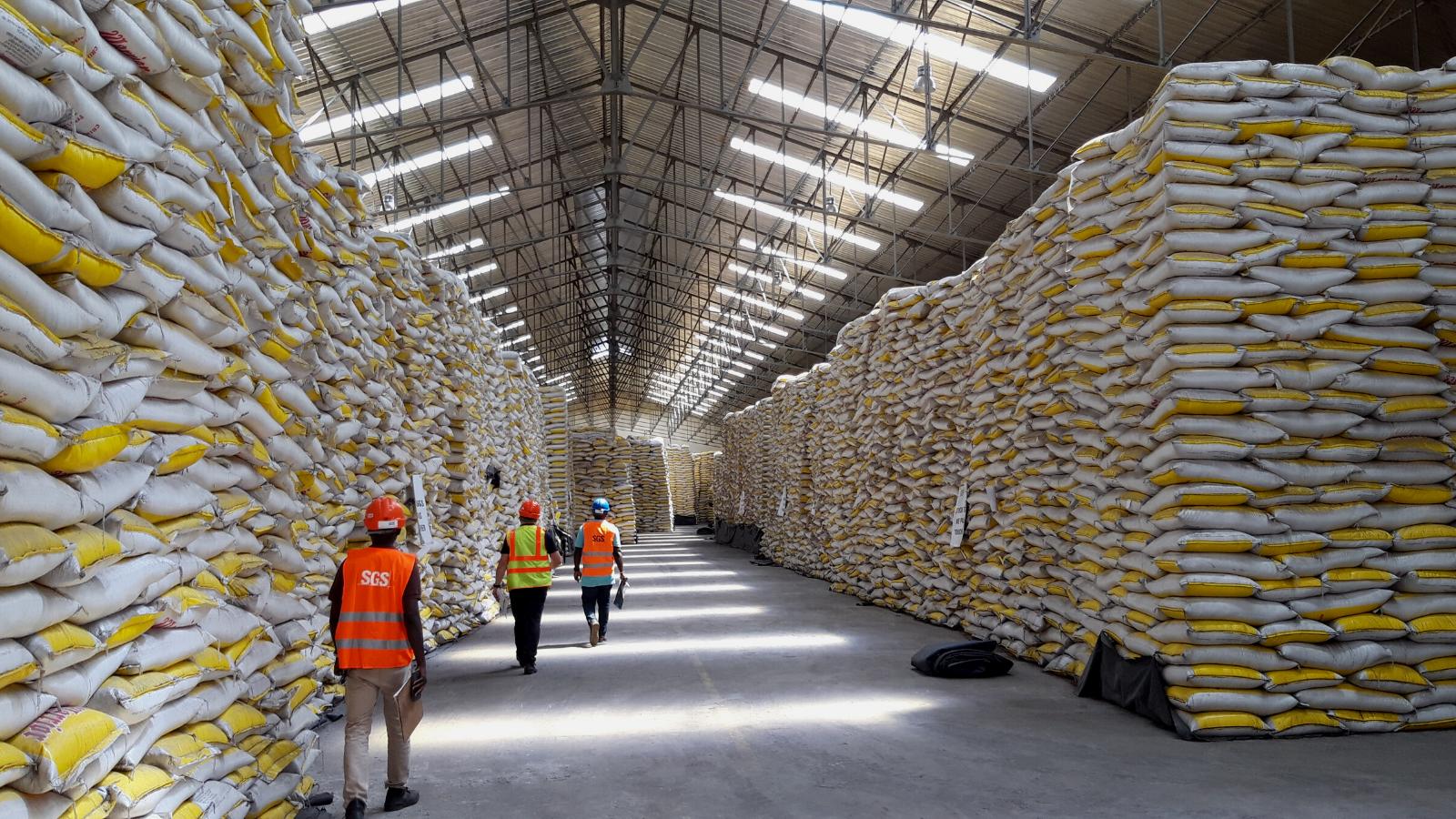
The Federal Government says it will release food reserves held under the Bank of Agriculture’s Guaranteed Minimum Price programme and make three million bags of fertiliser available within the next month. But the quantity of grain, selling prices and distribution arrangements have not yet been announced.
The Federal Government has announced plans to release grains purchased and stored under the Bank of Agriculture’s Guaranteed Minimum Price programme as part of a fresh intervention aimed at stabilising food prices across Nigeria.
The government has also announced plans to make three million bags of fertiliser available within the next month to reduce agricultural production costs and support farmers preparing for dry-season cultivation.
The announcements were made by the Minister of Agriculture and Food Security, Senator Abubakar Kyari, during the presentation of the 2026 Wet Season Agricultural Performance Survey Report in Abuja on Wednesday, November 18.
However, an important detail remains unresolved: although the government says the stored grains will soon enter the market, it has not yet published the quantity to be released, the selling prices, the distribution locations or the exact commencement date.
ALSO READ THE Nigeria’s New Airport Face-Recognition System Launches Monday
For households struggling with food costs, those details will determine whether the announcement translates into meaningful relief.
What exactly has the Federal Government announced?
The intervention has two separate components.
First: Release of stored grains.
The Ministry of Agriculture says grains purchased and stored under the Bank of Agriculture’s Guaranteed Minimum Price programme will be released into the market.
The programme was designed to provide farmers with a market for their produce at competitive prices while allowing the government to build food reserves.
According to the Agriculture Minister, the stored commodities will be released to help stabilise market prices and prevent excessive increases.
The minister said the government would announce the distribution arrangements.
The official announcement is available in the Federal Ministry of Information and National Orientation’s report, FG Unveils Measures to Reduce Food Prices, Pledges Market Stabilization and Food Sovereignty.
Second: Three million bags of fertiliser.
The Presidential Fertiliser Initiative is preparing to make three million bags available within the next month.
The purpose is to reduce input costs for farmers, support domestic fertiliser production and improve agricultural productivity.
This fertiliser intervention is connected to the earlier presidential directive announced by Vice President Kashim Shettima on November 16.
The Office of the Vice President explained that the government intends to purchase fertiliser produced by Nigerian blending companies and make it available to farmers at affordable prices.
The directive also included stock verification and efforts to ensure that farming communities affected by insecurity are not excluded.
ALSO READ THE Office of the Vice President’s announcement on the immediate fertiliser supply directive.
These are related agricultural interventions, but they are not the same programme: one concerns releasing stored food commodities, while the other concerns supplying fertiliser to farmers.
How much grain will be released?
This is one of the most important questions that remains unanswered.
The Agriculture Minister confirmed the intention to release stored commodities but did not provide a precise quantity in the announcement reviewed.
The government has also not published a complete breakdown of the available grain stocks by commodity, warehouse or location.
That information matters because the potential impact of a grain release depends on the volume entering the market relative to demand.
A small release may have limited influence on market prices, while a larger and properly distributed release could have a more substantial effect.
Without the quantity, Nigerians cannot independently assess the likely scale of the intervention.
The government should therefore publish an inventory showing the commodities available, their quantities, storage locations and planned release schedule.
Will Nigerians buy the released grains at cheaper prices?
The government says the intervention is intended to stabilise market prices.
However, it has not yet announced the final selling prices or the mechanism through which consumers, wholesalers, retailers and other buyers will access the commodities.
This distinction is important.
The release of stored grains does not automatically mean that every household will receive food at a subsidised price.
The eventual effect will depend on the distribution model, transportation expenses, handling charges, market access and the price at which the commodities are sold.
If the grains are released through selected traders or approved distribution channels, the government will need to explain how it intends to ensure that the intended benefits reach consumers.
The public should also know whether the commodities will be sold directly to households, through registered market operators, to food processors or through a combination of channels.
Until those arrangements are announced, claims that the government has already reduced food prices through the grain release would be premature.
Why the three million fertiliser bags matter to farmers
Fertiliser is an important agricultural input, particularly for farmers seeking to improve crop yields.
High input costs can reduce the amount farmers can afford to apply to their farms, potentially affecting production and profitability.
The Federal Government says the proposed three-million-bag intervention is intended to make fertiliser more affordable and improve the availability of locally produced agricultural inputs.
During the November 16 meeting, the Fertiliser Producers and Suppliers Association of Nigeria disclosed that available raw materials could support the production of approximately three million bags of NPK fertiliser within the targeted period.
The association also reported that its members held approximately 29,000 metric tonnes of finished NPK fertiliser that could be purchased and released.
These are industry figures presented during the government meeting. They should not be confused with a confirmation that three million bags have already been distributed to farmers.
The practical test will be whether the fertiliser is produced, purchased, transported and made available to farmers at the promised prices and within the announced period.
What the 2026 wet-season agricultural survey says
The announcement was made during the presentation of the 2026 Wet Season Agricultural Performance Survey.
The survey was conducted by the National Agricultural Extension and Research Liaison Services (NAERLS) at Ahmadu Bello University, Zaria, in collaboration with relevant state agriculture ministries, research institutions and development partners.
According to the survey presentation, 13 of the 17 major crops assessed are expected to record increased production in 2026.
The assessment covered wet-season farming activities and involved multidisciplinary teams conducting field assessments across the 36 states and the Federal Capital Territory.
The survey identified Niger State as the leading rice-producing state, Kano as the highest producer of sorghum and Yobe as the leading millet producer.
However, the Agriculture Minister said a separate dry-season assessment had been requested to establish the country’s overall agricultural output for the year.
This means the wet-season survey should not be presented as a complete assessment of Nigeria’s total agricultural production for 2026.
How will the intervention reach farmers in insecure communities?
The availability of agricultural inputs is only one part of food production.
Farmers also need access to their farms, transportation, storage, markets and reliable security.
In the November 16 fertiliser directive, Vice President Shettima tasked the Office of the National Security Adviser with verifying declared fertiliser stocks and ensuring that communities facing security challenges are not neglected.
This is important because insecurity can prevent farmers from cultivating their land or accessing agricultural inputs even when supplies are available.
The distribution programme will therefore need to consider farmers in vulnerable and hard-to-reach locations rather than concentrating only on easily accessible commercial farming areas.
The government should publish the eligibility criteria, participating distributors and geographical distribution arrangements so that farmers can understand how to benefit.
Five questions the government must answer
For the intervention to produce measurable results, Nigerians need clear answers to five questions.
1. How much grain is available?
The government should disclose the total quantity of rice, maize, sorghum and other stored commodities intended for release.
2. When will distribution begin?
A specific commencement date is needed so that traders, farmers and consumers can distinguish an announced plan from an active distribution exercise.
3. At what price will the grains be sold?
The government should publish the approved prices, distribution charges and eligibility conditions.
4. Where will the commodities be available?
The public needs a list of participating warehouses, distribution centres, approved traders or other authorised outlets.
5. How will diversion and hoarding be prevented?
ALSO READ THE INEC’s November 28 Mock Election: The Five Things Nigerians Should Watch Before 2027
Transparent stock records, public distribution information and independent monitoring would help establish whether the intervention is reaching its intended beneficiaries.
These questions are particularly important because a government food-reserve programme should be judged by its delivery, not simply by its announcement.
What should Nigerian households and farmers do now?
Consumers should continue comparing prices across legitimate markets and avoid paying unofficial agents who claim to have privileged access to government grain supplies.
Farmers preparing for dry-season cultivation should monitor announcements from their state agriculture ministries, the Bank of Agriculture and authorised fertiliser distribution channels.
They should not assume that the three million bags have already been distributed or that every farmer automatically qualifies.
The government should publish clear registration and access instructions before any distribution begins.
The real test: Will the announcement reach the market?
Nigeria’s latest agricultural intervention has the potential to address two important pressures: the cost of food for consumers and the cost of inputs for farmers.
But the impact will depend on implementation.
For the stored-grain programme, the most important missing information is the quantity, price, location and release timetable.
For the fertiliser intervention, the key measures are actual production, procurement, affordability and delivery to farmers before the relevant planting window.
The Federal Government has announced its intention to act. Nigerians now need the operational details that will allow them to measure progress.
The success of this intervention should not be judged by the number of grain bags or fertiliser bags mentioned in official statements. It should be judged by whether farmers receive affordable inputs, stored food reaches the market and households experience measurable improvements in food affordability.
NaijaGistToday will monitor the government’s distribution guidelines, the Bank of Agriculture’s grain-release arrangements and the actual delivery of fertiliser to farmers.